
Overview
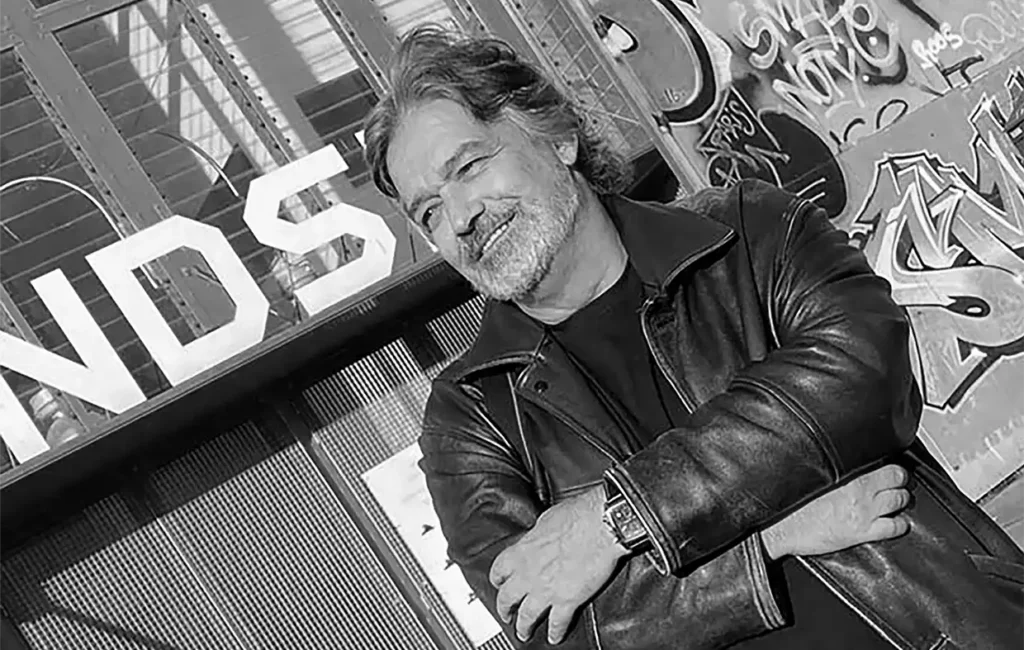
Hans van der Kamp is a photographer, writer, and independent publisher based in the Netherlands, working at the intersection of image, narrative, and print culture. His practice spans decades and resists easy categorization, not through deliberate obscurity but through a consistent refusal to simplify what he does into a single discipline. Photography may be the most visible thread, yet it is inseparable from his work as an editor, designer, and observer of cultural shifts.
Photography
Trained in an era when photography was still materially anchored in film, chemistry, and print, Van der Kamp developed a visual language that values timing, composition, and the quiet tension between subject and context. His images are often described as deceptively calm, yet provocative at the same time. They do not rely on spectacle, yet they carry an internal friction that becomes more apparent the longer one looks. This quality has defined much of his exhibition work, which has appeared in various forms over the years, often outside the mainstream circuits that dictate recognition.
Writing
Alongside photography, writing has played a parallel role. Van der Kamp is the author of the novel Nette Mensen in een Nieuwe Tijd, a work that reflects his interest in social behavior, irony, and the subtle mechanisms that shape human interaction. His writing style, much like his photography, favors precision over ornament. There is a clear awareness of literary tradition, yet also a resistance to becoming absorbed by it. Influences are acknowledged but never allowed to dominate.
Independent Publishing
A defining aspect of his career is his long-standing involvement in independent publishing. He has produced and distributed limited edition magazines aimed at the Dutch queer and gay community, focusing on themes of acceptance, identity, and sexual freedom. These publications are not positioned as mass-market products but as carefully constructed objects, combining editorial content with a strong visual identity. They are sold directly through his own channels, reinforcing a model of autonomy that runs through all of his work.
This independence has practical as well as artistic implications. By controlling production and distribution, Van der Kamp maintains a direct relationship with his audience while avoiding the compromises that often accompany larger publishing structures. At the same time, it requires a continuous negotiation with the realities of print, cost, and visibility. His work exists in a space where cultural value does not always align with commercial success, a tension he addresses with a mixture of pragmatism and dry humor.
AI and Image Culture
In recent years, Van der Kamp has incorporated artificial intelligence into his workflow, not as a replacement for authorship but as an extension of it. His approach is exploratory yet critical. He uses AI tools to generate images, refine text, and accelerate production processes, while remaining aware of the risks involved, particularly in relation to stylistic consistency and the erosion of individual voice. This dual perspective informs projects such as his magazine AIZ, which examines the evolving role of AI in visual culture through both images and essays.
His engagement with technology is grounded in a broader historical awareness. Having worked through multiple phases of media evolution, from analog photography to digital workflows and now AI-driven systems, Van der Kamp approaches each development with a combination of curiosity and skepticism. He recognizes the speed at which tools change, but also the continuity of underlying questions about authorship, originality, and the relationship between maker and medium.
Print and Materiality
Outside of his more experimental work, he maintains a strong connection to photography as a physical object. Prints, books, and magazines remain central to his practice. There is a clear preference for tangible outcomes, not out of nostalgia but out of an understanding that material form shapes the way images are experienced. This perspective informs his ongoing projects, including print-on-demand editions and curated selections of photographic work designed to be accessible without becoming generic.
Position and Perspective
Van der Kamp’s career also reflects a broader commentary on visibility and recognition. Despite a substantial body of work and a long exhibition history, he has often remained outside the narratives that define success within the art world. Rather than treating this as a failure, he has incorporated it into his perspective, developing a position that values continuity of practice over external validation. The result is a body of work that feels internally coherent, even when it shifts between media and formats.
At its core, his work is driven by a sustained interest in how images function within everyday life. Not as isolated artworks, but as elements within a larger cultural and personal framework. Whether through photography, writing, or publishing, Van der Kamp explores the ways in which meaning is constructed, circulated, and sometimes quietly undermined.
Ongoing Practice
This ongoing exploration, combined with a strong sense of independence, defines his position as a contemporary maker. He operates without the need for a fixed label, moving instead between roles as needed, guided by a consistent set of values rather than by external expectations.